

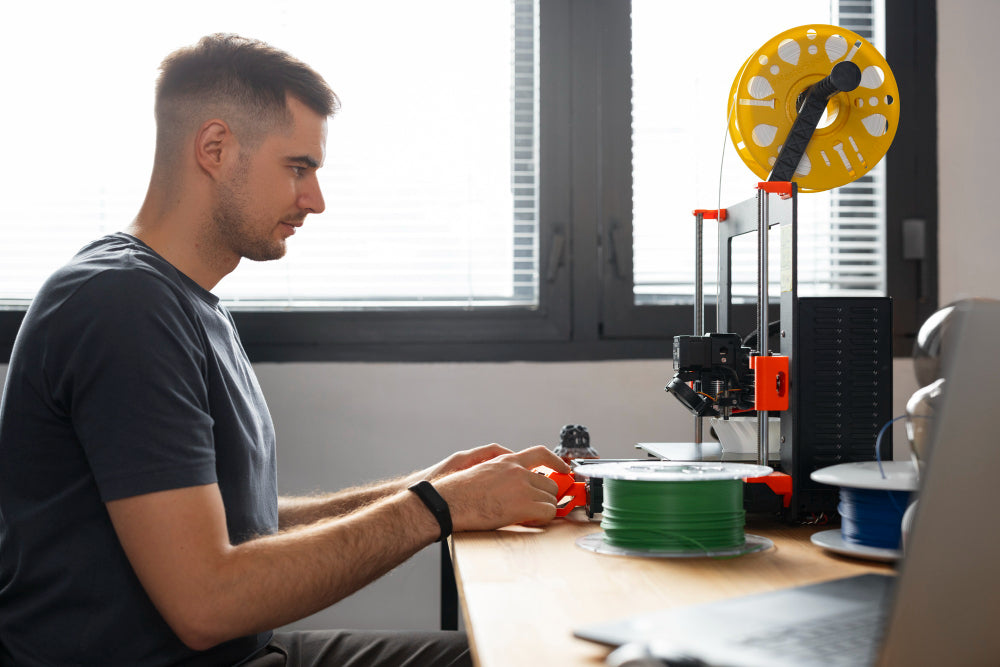
Metal 3D printing has become one of the most important shifts in industrial manufacturing because it gives companies a new way to create complex metal parts without relying exclusively on CNC machining, casting, or external suppliers.
For years, metal additive manufacturing was limited to advanced aerospace or research environments. Today, more manufacturers are evaluating metal 3D printers because the technology has become more practical, accessible, and useful for real production problems.
The strongest use cases for metal 3D printing are not always high-volume parts. Instead, metal additive manufacturing is often most valuable when a company needs complex geometry, faster iteration, lower tooling cost, internal replacement parts, or small-batch production. This makes the technology especially attractive for engineering teams, machine shops, maintenance departments, aerospace suppliers, and industrial manufacturers.
How Metal 3D Printing Works
Metal 3D printing creates parts layer by layer instead of removing material from a solid block. Different systems use different processes, including powder bed fusion, binder jetting, directed energy deposition, and bound metal extrusion.
In a typical industrial workflow, the part begins as a digital CAD file. The file is prepared in software, printed using a metal-compatible process, and then post-processed to reach its final mechanical properties. Depending on the system, post-processing may include debinding, sintering, heat treatment, support removal, or machining critical surfaces.
The major advantage is design freedom. Metal additive manufacturing can create internal channels, lightweight lattices, complex curves, part consolidations, and shapes that would be expensive or impossible to machine using traditional methods.
Markforged Metal X and Accessible Metal Printing
The Markforged Metal X is an important system for companies looking for a more accessible entry point into metal additive manufacturing. Rather than operating like a traditional loose-powder system, the Metal X uses a bound powder workflow. The printed part is washed and then sintered to become a dense metal component.
This workflow is appealing because it can reduce the operational complexity that often keeps smaller manufacturers from adopting metal additive manufacturing. It also allows teams to create metal parts internally for tooling, prototypes, low-volume production, and maintenance applications.
Common material options can include stainless steel, tool steel, copper, and other industrial materials depending on the platform and application requirements.
Metal 3D Printing vs CNC Machining
Metal 3D printing does not replace CNC machining in every situation. CNC machining remains excellent for high-volume production, tight tolerance surfaces, and parts that are simple to machine from standard stock. However, metal additive manufacturing is highly competitive when complexity, speed, and customization matter.
Metal 3D printing can reduce:
- Material waste
- Setup time
- Tooling requirements
- Assembly complexity
- Outsourced lead times
The best manufacturing strategy is often hybrid. A company may 3D print a near-net-shape part and then machine critical surfaces afterward. This allows additive manufacturing to handle complexity while machining delivers precision finishing where needed.
Metal 3D Printing Cost Factors
The cost of metal 3D printing depends on the printer, material, part size, post-processing, labor, and production volume. A simple cost comparison based only on machine price can be misleading. The bigger question is what the technology saves over time.
Important ROI factors include:
- Reduced supplier dependency
- Faster prototype cycles
- Fewer tooling delays
- Less material waste
- Lower inventory requirements
- Reduced machine downtime
For maintenance teams, the value may come from printing a replacement part quickly instead of waiting weeks for a supplier. For engineering teams, the value may come from testing multiple iterations in days instead of months.
Best Applications for Metal Additive Manufacturing
Metal additive manufacturing is strongest when the part benefits from complexity, customization, or fast availability. Common applications include functional prototypes, custom tooling, conformal cooling components, replacement parts, brackets, fixtures, heat exchangers, and low-volume production parts.
Industries using metal 3D printing include aerospace, automotive, energy, industrial manufacturing, defense, medical, and machine shops. The technology is especially valuable when conventional production is slow, expensive, or constrained by geometry.
FAQ Schema Questions & Answers
Can a 3D printer print real metal?
Yes. Industrial metal 3D printers can produce real metal parts using technologies such as powder bed fusion, binder jetting, or bound metal extrusion. Depending on the system, materials may include stainless steel, copper, tool steel, titanium, and other metals.
Is metal 3D printing cheaper than CNC machining?
Metal 3D printing can be cheaper for low-volume, complex, or customized parts, especially when it reduces tooling, waste, or outsourcing. CNC machining may still be more economical for simple, high-volume parts.
What is metal 3D printing used for?
Metal 3D printing is used for functional prototypes, tooling, replacement parts, brackets, fixtures, heat exchangers, medical components, aerospace parts, and low-volume production components.
How much does a metal 3D printer cost?
Metal 3D printer costs vary significantly based on technology, build volume, materials, and workflow requirements. Industrial systems can range from professional entry-level systems to high-end production platforms costing hundreds of thousands of dollars.
📚 Read Next: Best Industrial 3D Printers in 2026: Complete Buyer’s Guide


