

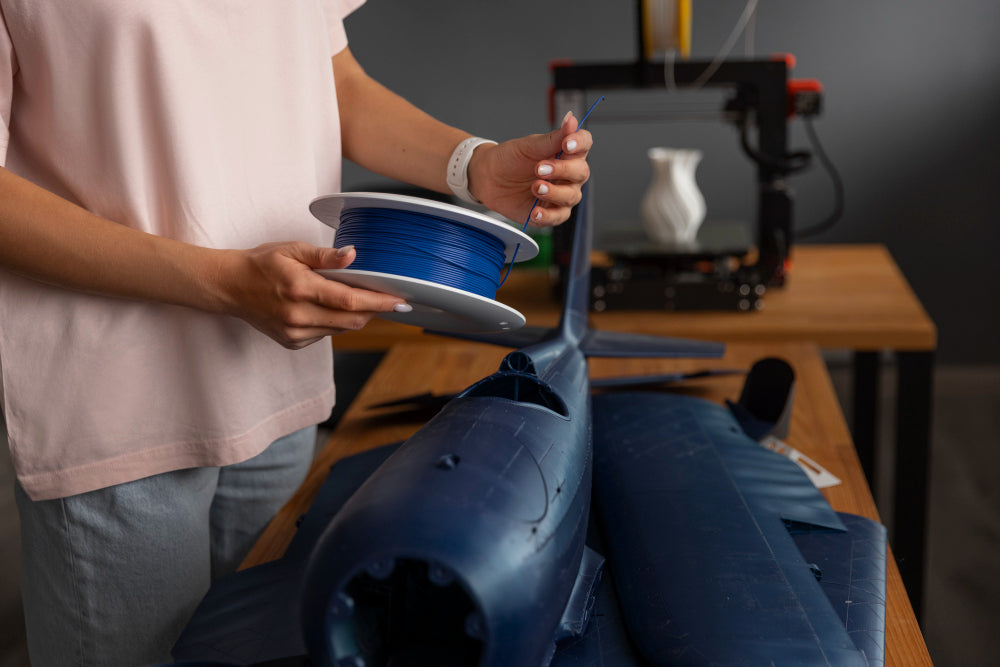
Carbon fiber 3D printing has changed how manufacturers think about tooling, fixtures, and functional production parts. Instead of waiting for machined aluminum components, engineering teams can now produce lightweight reinforced parts internally using industrial composite printers.
The question many buyers ask is simple: can carbon fiber 3D printing really replace aluminum? In some applications, yes. Carbon fiber reinforced parts can deliver excellent stiffness and strength-to-weight performance while reducing lead times and tooling weight. However, the best material choice depends on the application, load requirements, environment, and production use case.
What Is Carbon Fiber 3D Printing?
Carbon fiber 3D printing combines engineering-grade plastic with carbon fiber reinforcement. Some systems use chopped carbon fiber mixed into a base material, while more advanced industrial systems use continuous fiber reinforcement to place long strands of carbon fiber inside the part.
Continuous fiber reinforcement is what makes systems such as Markforged especially valuable for manufacturing. Instead of producing a simple plastic component, the printer can create a reinforced composite part that performs more like a structural manufacturing tool.
These reinforced parts are commonly used for jigs, fixtures, robotic tooling, inspection gauges, brackets, and production aids.
Carbon Fiber vs Aluminum: Where Each Material Wins
Aluminum is still an excellent manufacturing material. It offers strong mechanical properties, good machinability, heat resistance, and predictable performance. For high-heat environments, tight tolerance parts, or applications requiring metal properties, aluminum may still be the right choice.
Carbon fiber reinforced 3D printed parts win when weight reduction, speed, and design flexibility matter. In many tooling applications, the part does not need to be metal. It needs to be strong, rigid, lightweight, and available quickly.
Carbon fiber 3D printing can provide:
- Lower tooling weight
- Faster production
- Reduced machining cost
- Improved ergonomics
- Rapid design iteration
- Strong strength-to-weight performance
This is why manufacturers often replace machined aluminum fixtures with carbon fiber reinforced printed parts.
Why Robotics and Aerospace Teams Use Carbon Fiber Printing
Robotics integrators are some of the strongest users of carbon fiber additive manufacturing. Lighter end-of-arm tooling reduces payload, improves robot speed, decreases wear, and can make automation cells more efficient. A lighter tool may also allow a company to use a smaller robot or increase cycle performance.
Aerospace manufacturers use carbon fiber 3D printing for composite layup tools, assembly fixtures, and lightweight production aids. In environments where every pound matters, lightweight tooling can improve operator safety and reduce fatigue.
Best Carbon Fiber 3D Printers for Industrial Use
Markforged is one of the leading brands associated with industrial carbon fiber 3D printing. The Markforged X7 is widely used for factory-floor composite manufacturing because it can reinforce parts with continuous carbon fiber, fiberglass, or Kevlar.
The Markforged FX10 is relevant for organizations needing higher throughput and larger production workflows. The Mark Two is a strong desktop composite option for engineering teams that need professional reinforced parts without a larger industrial footprint.
Best Applications for Carbon Fiber 3D Printing
Carbon fiber 3D printing is best suited for functional tools and components where lightweight strength is more important than metal properties. Strong applications include robotic grippers, CNC soft jaws, drill guides, assembly fixtures, inspection fixtures, ergonomic tools, and replacement production aids.
The biggest advantage is speed. When a fixture breaks or a new tool is needed, a manufacturer can design and print the part internally instead of waiting for external machining. That speed can directly reduce downtime and improve production flexibility.
FAQ Schema Questions & Answers
Is carbon fiber 3D printing stronger than aluminum?
Carbon fiber 3D printed parts can offer excellent strength-to-weight performance and may replace aluminum in some tooling and fixture applications. Aluminum may still be better for high-heat, high-wear, or tight-tolerance metal applications.
What is a carbon fiber 3D printer used for?
Carbon fiber 3D printers are commonly used for manufacturing fixtures, robotic tooling, CNC soft jaws, aerospace tooling, inspection gauges, brackets, and functional prototypes.
What is the best industrial carbon fiber 3D printer?
The Markforged X7 is widely used for industrial carbon fiber additive manufacturing because it supports continuous fiber reinforcement and factory-floor tooling applications.
Can carbon fiber 3D printed parts be used in production?
Yes. Many manufacturers use carbon fiber reinforced 3D printed parts in production environments for tooling, fixtures, assembly aids, robotic grippers, and other functional applications.
📚 Read Next: Metal 3D Printing Explained: Cost, Machines, and Applications


